CASE STUDY
CREATE YOUR WORDLE PUZZLES. 0-1 BET.
CREATE YOUR WORDLE PUZZLES. 0-1 BET.
Role: Product Director, Gameplay (2022-2025)
︎ CHALLENGE
Wordle traffic was declining. Over the summer, we lost significant weekly active users due to school vacation, registration friction, and dropping acquisition. Wordle accounts for more than three-quarters of our total WAU. Our biggest audience and revenue engine was at risk.
My team had just delivered Wordle Archive, a conversion success that didn't solve engagement or reactivation. Senior leadership asked for a "bigger swing" to reactivate lapsed users.
Eight months later, we launched Create Your Wordle Puzzle, the New York Times’s first user-generated content product.
︎ MY ROLE
As Product Director, I led from prototype to global launch. My focus: engineering a product with network effects, creating flywheels and peer-to-peer dynamics to renew interest around Wordle.
︎ APPROACH
Making a popular game exciting again is uniquely challenging. But industry data shows that 60% of playtime goes to 6+ year-old games—think Pokémon, evolving from trading cards to Pokémon Go. Old games can stay popular with the right innovation. Here are the the approach to building conviction and navigating skepticism.
1. Setting Guardrails to Find the Right Idea
Define what the feature must do, narrow focus, weed out ideas that don't fit. The must-haves: peer-to-peer mechanic with network effects, drive top-of-funnel, executable within a quarter, no editorial investment. Each idea was positioned with clear criteria for leadership evaluation, showing the opportunity, execution risks, and complexity. Create Your Own Wordle emerged from brainstorming.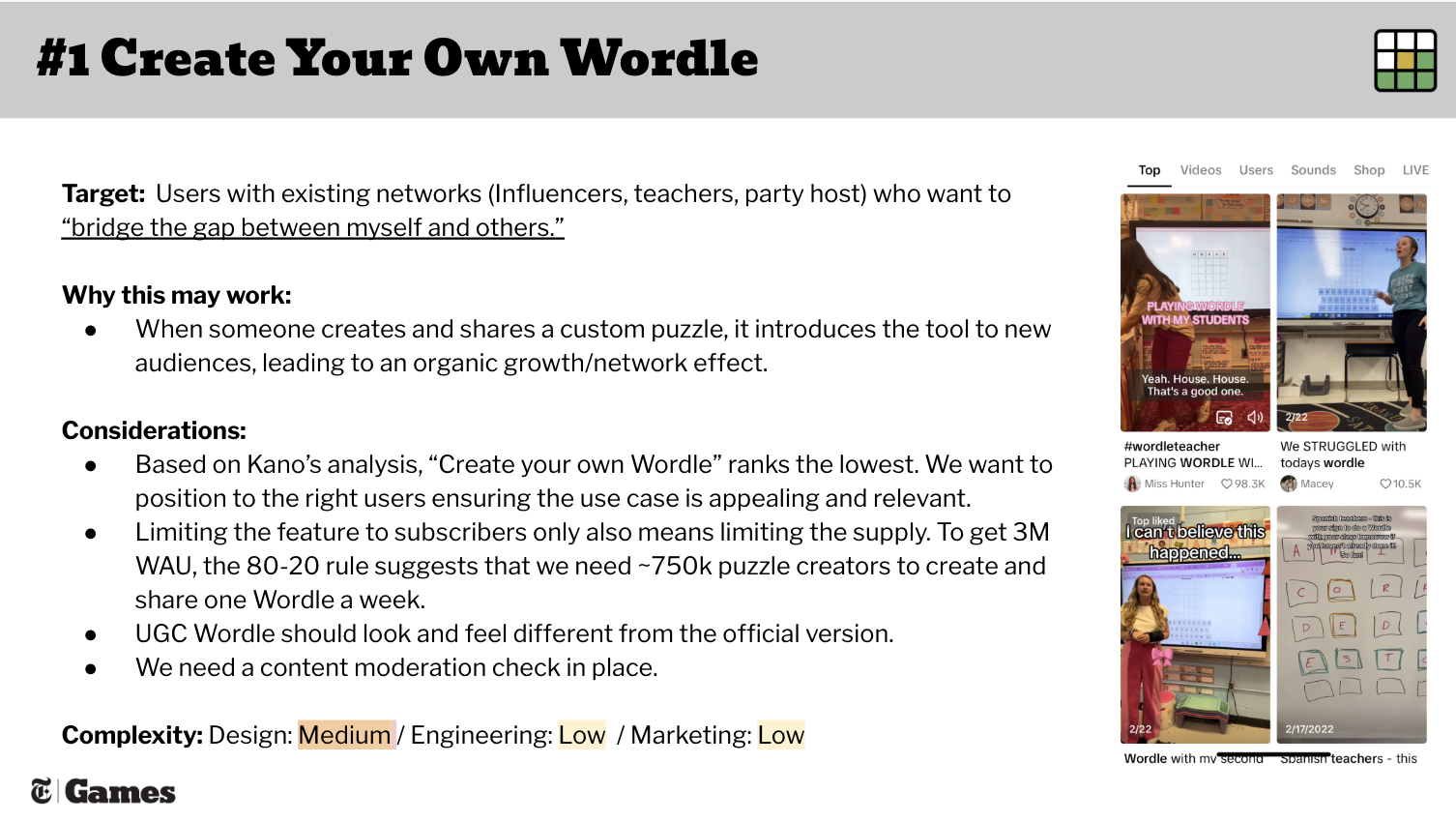
2. Building Conviction with Evidence
This 0-1 work had no playbook or data we could leverage. To get buy-in, we approached it like new game development:- Prototype: Built a few prototypes to playtest with teams and stakeholders, putting them into a creator mindset to experience the feature firsthand.
- Opportunity sizing: Applied the 80/20 rule for content creation: a small subset of creators drives outsized impact. I provided two models, assuming the feature is paid or free for registered users, and created low, medium, and high scenarios.
- User research: Diary studies and surveys revealed patterns we wouldn't have known—users chose words for people they knew or special occasions, not daily use. Flexibility in word length and custom hints were critical to adoption.
3. Design to Build Trust with Players and Creators
The biggest risk with UGC is maintaining quality without becoming another bootleg generator. The biggest product decision: subscribers create, everyone plays a UGC puzzle for free. This access model solved 80% of our risks in one move. By restricting creation to paid subscribers, we signaled quality and brand trust. By letting anyone play without an account, we maximized reach and virality. The constraint became the feature.4. Validate with Actual Users: The 28-Day Beta
Real users are the ultimate test. We designed an experiment that exposed the creation tool to 25% of web subscribers. Anyone who received a puzzle link could play for free.The primary success metric: measuring lift in weekly active players from UGC Wordles. Guardrail metrics included usage engagement, return rate, and cancellation attempts.
5. Follow-Through: Amplify the Launch with GTM and Sales
After getting greenlit for global launch as a new subscriber offering, timing it as the headline feature for the fall game sales. I pitched product marketing on recruiting NYT's renowned staff—editors, sports journalists, food writers—to create demo puzzles showcasing diverse use cases.The press release became our highest-traffic blog post ever. Well-timed sale + thoughtful campaign featuring our different use cases drove a ton of buzz, along with a 13% increase in subscription starts the day after launch.
︎ IMPACT
-
Creators: 7% of subscribers created puzzles (6.7% of subscriber DAU)
-
Puzzles created: 2M+ puzzles in first 3 months (88% in-app)
- Subscription starts: 13% increase the day after launch during sales
- New user acquisition: 20% of UGC Wordle players were new to the NYT Games ecosystem
- Churn reduction: 6% reduction in cancellation attempts among exposed users
- New vertical: Opened NYT Games' first UGC vertical.
︎ LEARNING
Perceived value matters. Create Your Own Wordle is occasionally used, but it increased subscription value. Users didn't need to create puzzles daily for it to impact what they felt they were paying for.
Sizing 0-1 work is often off-target. Projections assumed consistent usage from an audience motivated to share on social platforms. A wide range isn't useful—which is what I proposed. In hindsight, napkin math got us buy-in, but beta data would have been more valuable than broad forecasts.
Unproven bets need different talent. I'm grateful for a group of engineers, data analysts, and designers who navigated ambiguity, proactively solved problems, iterated quickly, and remained open to many ideas. Great work happens when great people are empowered to act. One of the highest compliments from an engineer: "This is the most fun I've had on a feature in a long time."
- ︎